
Here’s what’s happening today.
Your creative team just wrapped a six-week campaign shoot. The footage is immaculate. It’s sharp, colour-graded within an inch of its life, lit with the precision of a surgical theatre. It looks expensive. It looks perfect. And the moment it hits TikTok, it gets scrolled past in 0.8 seconds flat.
Meanwhile, a 22-year-old with a beat-up Sony camcorder from 2001 is getting 2 million views posting footage that looks like it was filmed through a jar of Vaseline.
It’s an emerging short-form aesthetic that might just become mainstream soon.
First, what even is this?
An increasingly powerful segment of consumers have developed a deep, almost irrational love for video that looks old. Not vintage-filtered-in-post old. Actually old.
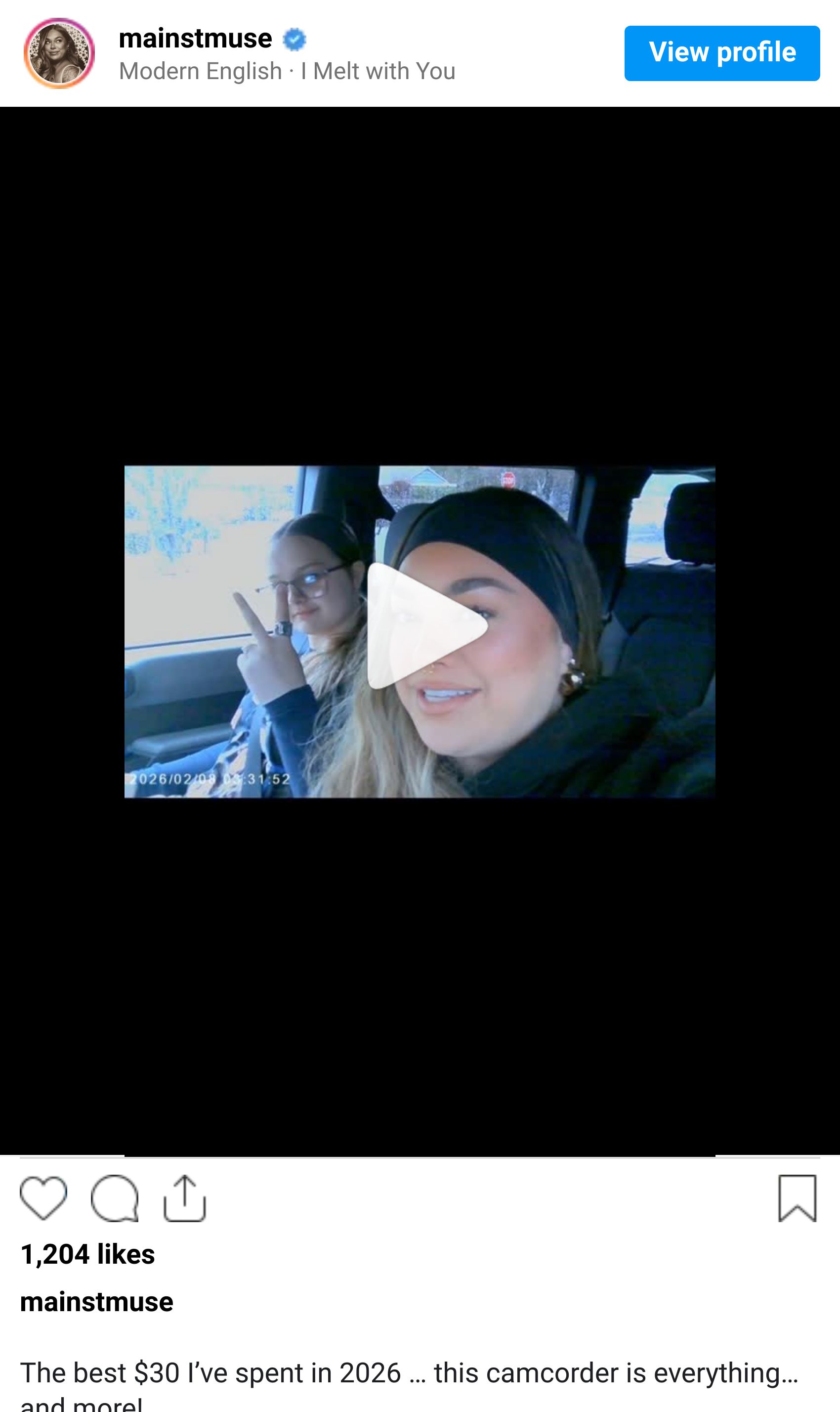
We’re talking Mini DV tapes, Hi8 camcorders, that distinctive pixelated grain from an early 2000s Handycam. The tracking errors. The washed-out highlights. The autofocus hunting awkwardly across someone’s face.

They are Gen Z, Gen Alpha, and the younger Millennials that see these “flaws” as features.
The value of an image in 2026 is no longer derived from its resolution but from its perceived proof of life.
The global digital camcorder market hit $3.13 billion in 2025 and is on track for $3.45 billion by end of 2026. It’s compounding at 10.2% (annual growth rate) in a category that everyone thought smartphones had already killed.

Okay, but why?
Before you dismiss this as “kids being weird,” you need to understand what’s actually driving it. Because it’s not random, and it’s not going away.
Reason 1: AI has made perfection worthless
Generative AI can now produce flawless 8K imagery with almost no human input. Which means flawless 8K imagery now feels automated.
Suspicious.

When everything can look perfect, perfection stops being a signal of quality and starts being a signal of fakeness. Younger audiences who have grown up fluent in spotting AI content are using visual imperfection as a trust indicator.
A shaky handheld shot and natural lighting have become, in their eyes, “proof of humanity.” A pixel-perfect campaign has become proof that a machine made it.
Reason 2: Anemoia brings nostalgia for a time they never lived
There’s a word for what Gen Z feels when they watch footage shot on a 2002 camcorder: anemoia.
It means nostalgia for an era you never personally experienced. Gen Z grew up in a hyper-digital world. Always-on, always-surveilled, always-optimized.
The early 2000s, to them, represents a kind of creative freedom and “low-stakes” digital culture they never got to have.
The Y2K aesthetic like the fisheye lenses, metallic surfaces, that specific camcorder glow, triggers a fantasy of simpler times. Not their own memories. The fantasy of someone else’s memories.

This is not a retro trend in the traditional sense. Gen Z isn’t reminiscing. They’re romanticising.
They’re building an identity around an era they didn’t live through.
That’s a fundamentally different emotional mechanism than, say, Millennials getting nostalgic for the ’90s. It means the aesthetic is not going to fade when the actual memories do, because there are no actual memories to fade.
Reason 3: lo-fi is agile, and agility is power
Here’s a practical one. Lo-fi production doesn’t need a three-week pre-production cycle. A creator with a vintage camcorder and a halfway decent eye can respond to a cultural moment in hours.
High-end production can’t compete with that speed. In a landscape where trends live and die in 72-hour cycles, the ability to move fast matters more than the ability to look polished.

Legacy brands already doing it
This isn’t theoretical. Major brands have been experimenting with lo-fi and Y2K aesthetics in their campaigns, and the results are worth paying attention to.
Gap launched a campaign called “Better in Denim” in 2025, specifically targeting trendy Gen Zs who’d been drifting toward fast-fashion competitors. The campaign absolutely used Y2K nostalgia and music-video energy, and youthful cultural cues. The result: a successful reanimation of their
Coca-Cola’s “I Feel Coke” ad was inspired by the concept of Anemoia to evoke the emotions tied to Coca-Cola from past eras while reimagining them in a fresh, modern way.
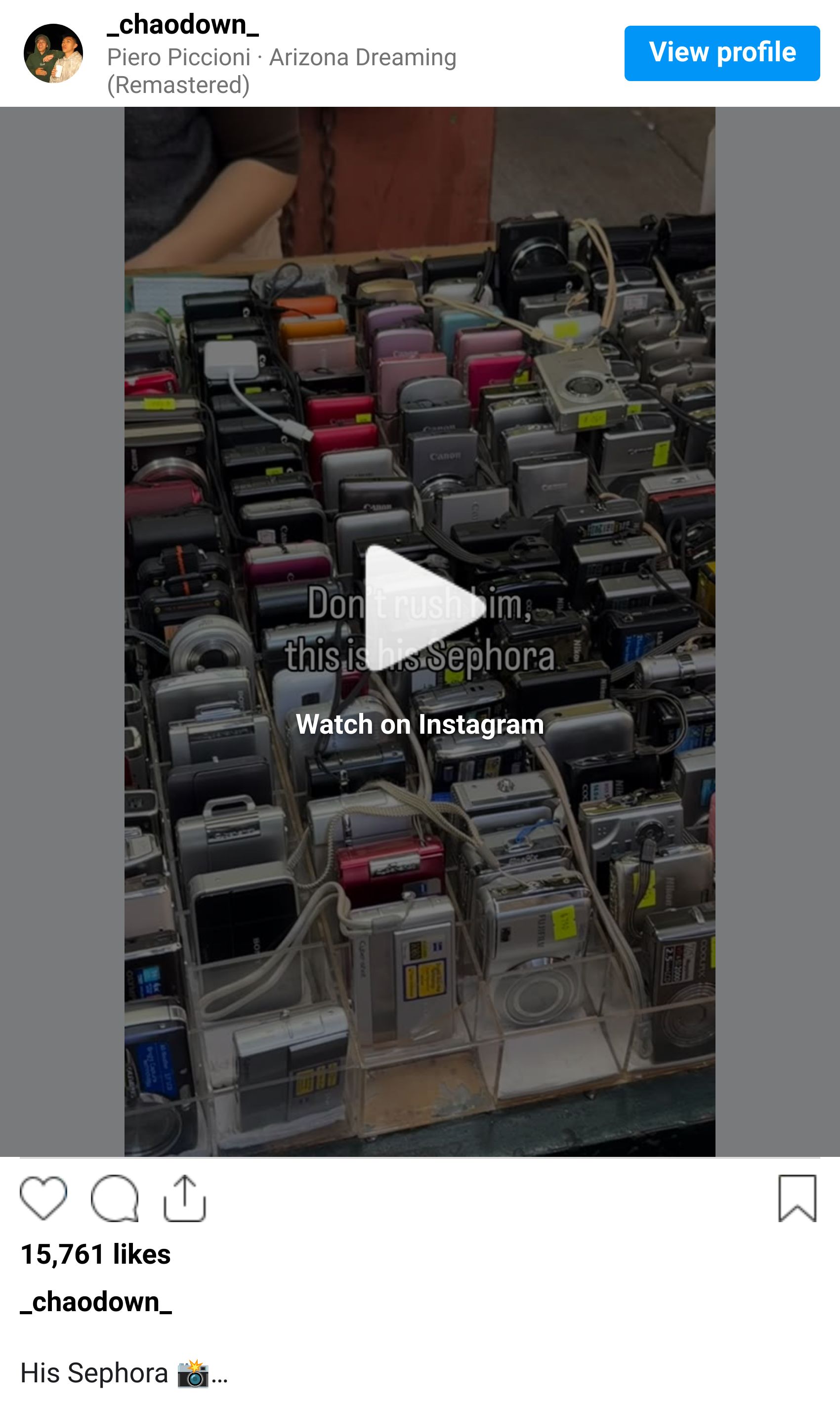
The Resale Market Boom
MODEL | PRICE (REFURB) | KNOWN FOR |
Sony DCR-TRV350 | $250–450 | NightShot infrared glow, Hi8 compatibility |
Sony CCD-TRV87 | $279–347 | Early CCD “glow” that can’t be replicated in post |
Panasonic PV-L858 | $50–150 | Vibrant reds, punchy contrast, manual exposure |
JVC GR-SXM260U | $20–110 | Late-90s road trip aesthetic, tracking glitches |
Canon ES8600 | $40–90 | Warm audio, monochrome viewfinder aesthetic |

The supply problem: In February 2025, Sony officially ended production of Mini DV cassettes. The market of “New Old Stock” and second-hand tapes are becoming scarcer and more expensive.
Older tapes are starting to degrade: a phenomenon called “oxide flaking.” This means the aesthetic has a real-world scarcity element baked into it, which only amplifies its cultural cachet. Things that are hard to get feel more authentic. Vinyl, anyone?
What this actually means for marketers
How do we translate this to action? Surely, the point isn’t to tell every brand to go buy a Sony camcorder from 2001.
The point is to understand the underlying value system driving this shift, because that value system should be informing how you think about production, content, and your relationship with your audience.
1. Audit your production values against your audience’s trust signals.
If your target consumer is under 30, ask honestly: does our current visual aesthetic read as “authentic” or as “AI-generated corporate content”?
It’s not a question of whether it looks good. It’s a question of what your production choices are signalling.

2. Build a lo-fi content track alongside your hero content.
You don’t have to abandon high-production campaigns. But you should have a parallel content stream: UGC-style, creator-led, intentionally raw that gives your brand a human face.
The strategy is layered, not either/or.

3. Stop briefing for perfection on social.
The 6-week production timeline is a liability on TikTok and Instagram Reels. Social-first content should be built for speed and cultural responsiveness.
Shorter lead times, more creator latitude, genuine tolerance for imperfection.

4. Understand that “weird” is a strategic asset.
The deliberate use of “intentional contradiction” from quirky music to unexpected visuals breaks the rhythm of commercial sameness. It is a calculated move to make brands feel uncopyable and human.
If your campaign could have been made by any brand, it wasn’t differentiated enough. Get your weird on.

5. Pay attention to which young filmmakers your target audience follows.
The next wave of directors and cinematographers are those who grew up literally filming things on their dad’s camcorder.
Building relationships with them now is not a nice-to-have.

The bigger picture
This Linear Renaissance is a symptom of something much larger: a generation that is actively suspicious of polish, precision, and perfection because they have correctly identified those qualities as the native language of artificial intelligence and corporate inauthenticity.

In that context, the 20-year-old camcorder isn’t a limitation. It’s a credential. It says: a human held this. A human pointed it at something they found worth filming. A human pressed record.
And in 2026, that’s worth more than 8K.